 Jasvel
 Swiss Jass: the rules, the reckoning, and a Schieber table for your phone
Every rule of Schieber written out with the numbers it actually uses, every regional variant named instead of quietly picked, and free scoreboards you can open at the table. Jasvel, the app, plays the same game offline against three computer opponents.
Coming soon to the App Store and Google Play
36
cards
9
each
157
points a round
1000
to win
A computer that does not look at your hand
Every computer seat in Jasvel — your partner included — decides from what it can legally see: its own nine cards, the cards already played, how many cards everyone still holds, and the score. There is no difficulty setting that peeks, because the type the engine hands to a computer player physically cannot hold another hand. It is the one claim in this niche worth making, and it is the one most easily checked.
Free, in the browser
Keep the score without keeping the chalk
Four scoreboards and a rules arbiter. Nothing is sent anywhere and nothing needs an account — open one at the table and close it when the round ends.
- Weis calculator Compare a Weis by points, card count, highest card, trump suit and seat position, then confirm the winning meld at the table.
- Coiffeur scoresheet A Coiffeur scoresheet records each contract once, keeps only the tens of every round and uses the printed factor for the selected column.
- Differenzler scoresheet Record the target, the scored blocks and the trick result, then check the 157-point base total before carrying the game forward.
- Who wins the trick The strongest card in the controlling suit takes the trick, with the contract deciding the rank order and any trump taking priority.
Which cards you play with depends on where you are sitting
Learn the game, one rule at a time
Each page answers one question completely, with the numbers the Swiss sources publish and the variants named where tables disagree.
- 01 Schieber rules Learn the complete Schieber Jass round, from dealing and schieben to following suit, declarations, multipliers and the winning score.
- 02 Card values Jass card values depend on the contract, but every deal contains 152 card points before the 5-point last-trick bonus.
- 03 Weis Jass Weis compares declared melds, and only the team with the single best meld scores Weis for both partners.
- 04 Stöck Stöck is the 20-point combination of the trump king and Ober in one hand, declared as you play the second card.
- 05 Trumpf, Obenabe, Undenufe The forehand selects a suit, Obenabe or Undenufe, and that contract fixes card strength, card values and the multiplier for the round.
- 06 Following suit Farbzwang requires the led suit when possible; trump rules then decide whether you must overtrump, may undertrump or can keep the Puur.
- 07 Schieben Schieben passes the contract choice from the forehand to the partner once, while the forehand remains responsible for leading the opening trick.
- 08 Writing the score A Jasstafel records each team’s score with grouped strokes, symbols and a remainder, then preserves the order in which a target is reached.
- 09 Match and target A Jass game ends when a team reaches its target, but a close round is decided by the order in which each score block is counted.
- 10 Dealing and seating Seat partners opposite, deal counter-clockwise in groups of three, and let the player on the dealer’s right choose the contract and lead.
- 11 How to play Jass Learn one complete round of Jass, from the deal and contract to legal tricks, card points, bonuses and the final entry on the Jasstafel.
- 12 Swiss or French cards Swiss-German and French cards belong to the same Jass tradition: regional symbols differ, but the suits, ranks and scoring positions correspond.
- 13 What Jass is Jass is a Swiss family of trick-taking games for four players, using a 36-card pack, fixed partnerships, contracts and nine tricks.
The app
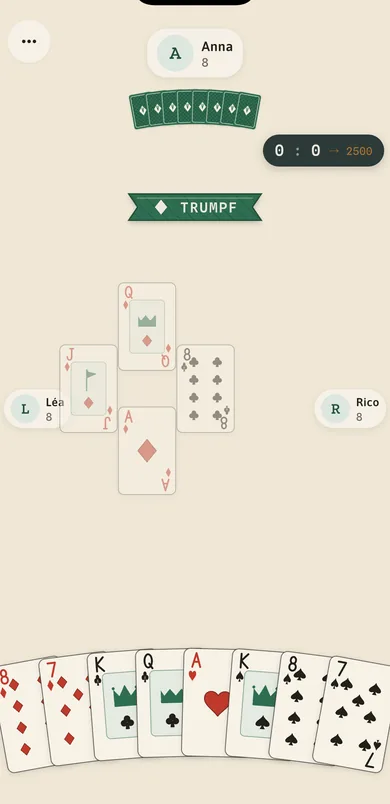
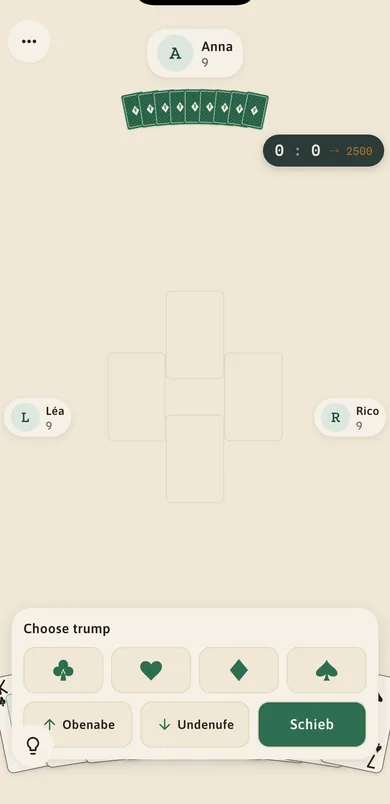
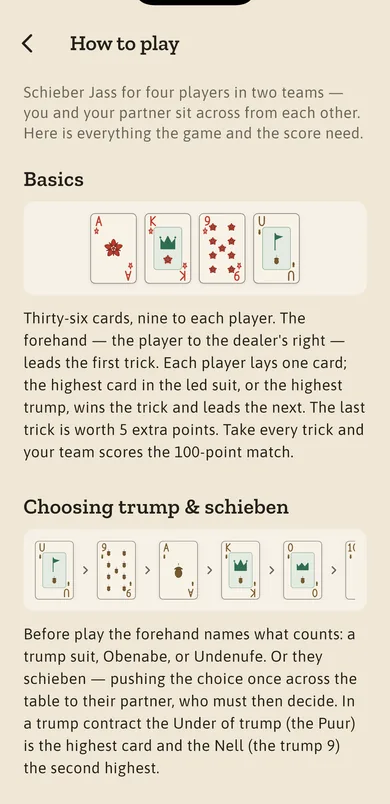
A Schieber table for one player and three computer opponents. It is finished; the store listings are not open yet.
- Both decks — Swiss-German and French — and the full score with Weis, Stöck, match and the multipliers
- Trump suits, Obenabe and Undenufe, schieben, and pass-and-play on one device
- No account, no advertising, no data collected, and it works with the aeroplane mode on
About this site
What does a Swiss Jass reference explain?
A Swiss Jass reference explains the complete Schieber rules in English, from the deal and contract choice to trick play, declarations and the final score. The guide is written for readers outside Switzerland, including Swiss diaspora and experienced card-game players who know trick-taking games but not Swiss Jass terminology.
Schieber is the partnership form of Swiss Jass. Four players form two fixed teams, with partners sitting opposite each other. Each player receives 9 cards from a 36-card pack, and the round contains 9 tricks. Cards are dealt three at a time, play runs counter-clockwise and the dealer rotates after each round.
The forehand is the player to the dealer's right. The forehand chooses the contract and leads the first trick. The forehand may also pass the choice to the partner exactly once. This action is called Schieber, meaning the passing of the contract choice. The partner must then choose the contract and may not pass the choice back.
The guide keeps Swiss German terms of art instead of replacing them with loose English equivalents. Obenabe means a high-card contract, while Undenufe means a low-card contract. Weis means declared card combinations. Stöck means the king and Ober of the trump suit held together in one hand. The terms remain distinct because they affect different parts of the game.
A player who knows another trick-taking game can understand the broad structure quickly, but the details determine the result. The first decision belongs to the forehand. The contract determines the card order and the scoring context. The last trick has its own bonus. Weis and Stöck follow declaration rules, and Stöck depends on the timing of the second card.
The Schieber rules page gives those details in a form that you can consult before a game or during a disputed play. It does not reduce the game to a short list of card values. It explains who acts, what each choice means and what consequence follows when a player misses a required moment.
The reference also separates rules from tools. A score screen can record a result, but it cannot decide which regional rule a table follows. The rule pages therefore explain the practice first, then show how a player can use the scoreboards or app without confusing equipment with the rules themselves.
Which Swiss Jass variants does the reference cover?
The reference covers Schieber, Obenabe and Undenufe as named forms of Swiss Jass. Schieber uses a contract choice passed between partners at most once, while Obenabe and Undenufe are non-trump contracts with different card orders. Stöck does not exist in Obenabe or Undenufe.
Schieber is the form most closely associated with fixed partnerships and the passing decision. The forehand chooses a contract or pushes the choice to the partner. Once the partner receives that choice, the partner must decide and cannot push it back. The action changes who makes the contract decision, but it does not create another opportunity to pass.
Obenabe and Undenufe require careful wording because their names describe the direction of the card order. Obenabe gives priority to higher cards. Undenufe gives priority to lower cards. Neither contract uses a trump suit, so the trump-specific Stöck declaration is not available. A rule that applies to a trump contract must not be carried into either of these forms without qualification.
Swiss Jass practice varies between regions, families, clubs and published rule tables. One table may record a rule differently from another while both traditions remain established forms of play. The reference names the regional variants where they matter and identifies disagreements instead of presenting one table as the only correct version.
That distinction helps readers compare a local game with a published description. A player who learned Jass from relatives in Switzerland may recognise a rule that differs from a club table or another canton. The guide does not erase that difference. It tells you which practice the page describes and where another named variant changes the result.
The glossary gives short explanations for the language used across the pages. Puur means the jack in a trump suit, and Nell means the 9 of the trump suit. Swiss Jass vocabulary supplies the basic meaning of these terms, while the rule pages explain how the cards behave in a contract.
Weis and Stöck also need separate treatment. Weis concerns declared combinations. Stöck concerns the king and Ober of the trump suit held in one hand, and its 20 points belong to the team regardless of the Weis comparison. Stöck is therefore not simply another Weis entry, and it cannot be assumed in Obenabe or Undenufe.
How does Swiss Jass scoring work?
Swiss Jass scoring begins with 152 card points in the 36-card pack, plus 5 points for the last trick. A normal round therefore contains 157 points before any match bonus. The team that wins all 9 tricks receives an additional 100 points, giving 257 points for the match.
Each player receives 9 cards, so the deal produces 9 tricks. Card points come from the cards won in those tricks. The last-trick bonus is added separately. A team that takes every trick receives the 100-point match bonus. These parts explain the basic trick total before the table considers Weis, Stöck or the target.
Stöck means holding the king and Ober of the trump suit in one hand. The player declares Stöck while playing the second of those 2 cards, not while playing the first. The declaration must happen at that moment. If the next player has already covered the second card before the declaration is spoken, the 20 points are lost.
Partners may not remind each other to declare Stöck. The obligation belongs to the player holding the cards. The rule therefore rewards accurate timing rather than a later correction. Stöck is credited to the team regardless of the Weis comparison, but it exists only when the round has a trump suit. Obenabe and Undenufe have no Stöck.
Targets used in practice include 1000, 1500, 2500 and 3000. The app offers 1000 and 2500. These target choices describe different practices and app settings, not a universal target for every Swiss Jass table.
When a round takes a team past the target, the points are counted in a fixed order: Weis first, then Stöck, then tricks. A team crossing the target in an earlier block wins. For example, a team may cross the target during the Weis block even if the other team would have reached the target through Stöck or trick points later in the same round. The comparison follows the scoring blocks rather than only the final combined total.
The card values page keeps the card order and card points together, while the scoring guidance explains the last trick, the match bonus, declarations and target crossings. If a regional table uses a different practice, the relevant page identifies that variant rather than hiding it inside one unexplained total.
Which Swiss Jass tools can I use at the table?
The site provides free browser scoreboards for recording a Swiss Jass game at the table. A scoreboard keeps team totals visible and reduces the need to calculate every addition by hand. It records the result that players enter; it does not replace the rule that determines how the result should be counted.
The Jasstafel scoreboard follows the language of the game. Jasstafel means a Jass scoreboard. You can use the tool to record trick points, Weis, Stöck, the match bonus and the progress towards the chosen target. The scoreboard is most useful when the players have already agreed which regional rules govern the game.
A score entry still needs a rule behind it. If a table disputes the value of a declaration or the treatment of a regional variant, the scoreboard cannot settle that question by itself. The reference pages provide the explanation, and the Jasstafel provides a clear place to record the agreed result.
The app provides an offline way to play through the same game. It follows the structure described in the reference: 4 players form 2 fixed teams, partners sit opposite each other, cards are dealt three at a time, play runs counter-clockwise and the dealer rotates after each round.
The app supports the 1000 and 2500 targets. Practice tables may instead use 1500 or 3000. The app's target choices therefore describe its available settings and do not claim that every table uses the same target.
The app is not a place to play against other people. It does not provide a shared table, a meeting place or a way for separate players to connect. The browser scoreboards have the same limited purpose: they record a game already being played rather than arranging play between different people.
The app page explains the app's offline role and its supported settings. You can use the rule pages to learn the game, the Jasstafel to record a table's score and the app to play through the same form of Jass offline. Each tool has a defined purpose, so the description does not promise features that the publisher does not provide.
How are the Swiss Jass rules organised and compared?
The Swiss Jass rules are organised from published Swiss sources and compared where their descriptions differ. The pages preserve Swiss German terms of art, explain the action at the table and identify the regional practice attached to a disputed rule. The result is a reference that shows its basis instead of presenting an unexplained summary.
Each rule page begins with the information needed for the decision in front of the player. It identifies who acts, which cards matter, when the choice must be made and what happens if the required timing is missed. This structure is especially useful in Schieber, where the forehand may pass the contract choice to the partner exactly once, but the partner must choose and may not pass it back.
The deal and seating rules establish the order of play. Partners sit opposite each other. The forehand sits to the dealer's right, chooses the contract and leads the first trick. Cards are dealt three at a time, play runs counter-clockwise and the dealer rotates each round. A short summary can easily omit one of these details, even though each one affects who makes the first decision.
The reference keeps shared rules separate from regional rules. Where published tables agree, the guide states the common practice directly. Where they differ, the guide names the variant and explains its consequence. It does not silently choose one regional table and describe every other table as incorrect.
The vocabulary follows the same method. Schieber is the passing choice. Obenabe and Undenufe name the high-card and low-card non-trump contracts. Weis means declared card combinations. Stöck means the king and Ober of the trump suit held in one hand. Puur and Nell identify important trump cards when the card order requires those terms.
Timing receives the same attention as card value. A player declares Stöck while playing the second of the 2 cards, not the first. If the next player has already covered that card before the declaration, the 20 points are lost. Partners may not remind one another. The rule page presents that sequence as part of the play, not as an optional note after the score.
The reference is designed for repeated use. A new reader can follow the game from the deal onwards. An experienced player can check a term or a regional difference. A table can consult the scoring order before a target crossing and then use the Jasstafel to record the agreed result.
Questions
Can a player pass the contract choice more than once in Schieber?
No. The forehand may pass the choice to the partner exactly once. The partner must choose the contract and may not pass the choice back.
Who leads the first trick in Swiss Jass?
The forehand leads the first trick. The forehand is the player sitting to the dealer's right, and the dealer rotates after each round.
What happens if a player forgets to declare Stöck in time?
The player must declare Stöck while playing the second card of the king-and-Ober pair. If the next player has already covered that card before the declaration, the 20 points are lost.
Does a team receive Stöck points even if it loses the Weis comparison?
Yes. Stöck is worth 20 points and is credited to its team regardless of the Weis comparison. The declaration applies only to the king and Ober of the trump suit held in one hand.
How many points are available in a Swiss Jass round?
The pack contains 152 card points, and the last trick adds 5 points, making 157 points. Winning all 9 tricks adds a 100-point match bonus, producing 257 points for the match.
Which target settings does the app provide?
The app provides target settings of 1000 and 2500. Swiss Jass practice also includes 1500 and 3000, but those targets are not listed as app settings here.